
- Aasiya Niaz
- 3 Hours ago
US conducts airstrikes on Islamic State targets in north-west Nigeria
-

- Web Desk
- Dec 26, 2025
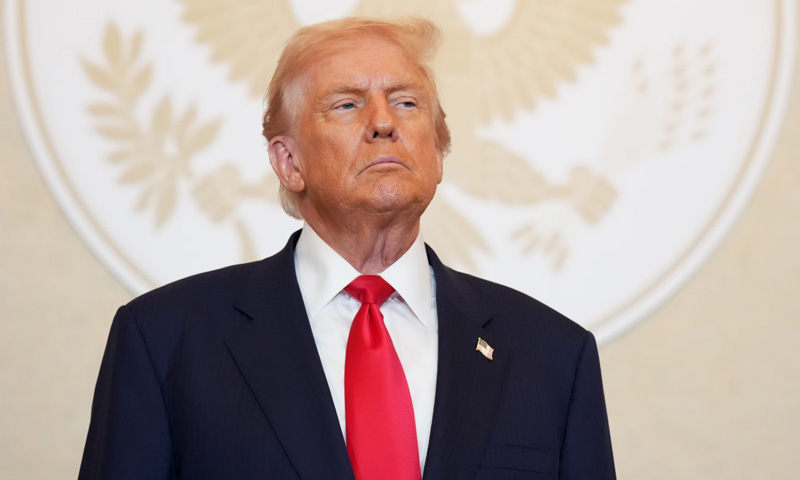
WEB DESK: The United States carried out airstrikes against Islamic State (IS) militants in north-west Nigeria on Christmas Day, President Donald Trump said, marking the first known US military action in the country during his second term and intensifying Washington’s focus on violence that it says disproportionately affects Christian communities.
In a series of posts on his Truth Social platform late Thursday, Trump said the strikes were “powerful and deadly” and targeted IS fighters operating in Sokoto state. He accused the militant group of “viciously killing, primarily, innocent Christians” and said the operation followed repeated warnings from Washington.
“Tonight, at my direction as Commander in Chief, the United States launched a powerful and deadly strike against ISIS terrorist scum in northwest Nigeria,” Trump wrote. “I have previously warned these terrorists that if they did not stop the slaughtering of Christians, there would be hell to pay, and tonight, there was.”
The Nigerian government later confirmed the strikes, describing them as precision attacks carried out as part of ongoing security cooperation between Abuja and Washington.
Nigeria confirms ‘precision hits’ amid security cooperation
Nigeria’s foreign ministry said early Friday that the airstrikes were conducted in coordination with Nigerian authorities and involved intelligence sharing and strategic planning between the two countries.
“This has led to precision hits on terrorist targets in Nigeria by air strikes in the North West,” the ministry said in a statement, adding that the country remained engaged with international partners to address terrorism and violent extremism.
The US military’s Africa Command (Africom) said multiple IS militants were killed in the operation, which it said took place in Sokoto state. While an earlier Africom post on social media indicated the strike had been conducted at Nigeria’s request, that statement was later removed. No figures were provided on casualties, and independent verification was not immediately possible.
US Defense Secretary Pete Hegseth said he was “grateful for Nigerian government support and cooperation,” signalling official backing from Abuja despite sensitivities surrounding foreign military operations on Nigerian soil.
Trump’s focus on Christian persecution
Trump has repeatedly highlighted violence against Christians in Nigeria, framing it as part of a broader global campaign of religious persecution. In recent months, he warned that Washington could take “guns-a-blazing” military action if attacks continued, and last month threatened to cut off US aid to Abuja.
In another Christmas Day message, Trump added: “Merry Christmas to all, including the dead terrorists — of which there will be many more if their slaughter of Christians continues.”
Earlier this year, the United States placed Nigeria back on its list of countries of “particular concern” regarding religious freedom and imposed visa restrictions on some Nigerians, citing ongoing violence.
Nigeria is officially a secular state and is almost evenly divided between Muslims and Christians, with Muslims forming a majority in the north and Christians concentrated largely in the south.
Disputed narrative of religious persecution
Nigeria’s government and many independent analysts reject the framing of the country’s security crisis as a campaign of religious persecution. They argue that armed groups routinely target both Muslim and Christian civilians, and that violence is driven by a complex mix of factors including criminality, local conflicts over land and resources, and weak governance.
In parts of central and north-western Nigeria, clashes between predominantly Muslim herders and largely Christian farming communities have long been rooted in competition for land and water. Kidnappings for ransom — including of priests and pastors — have surged in recent years, though analysts say many such attacks are motivated by profit rather than ideology.
In the country’s northeast, jihadist violence linked to Boko Haram and its offshoots has persisted for more than 15 years, leaving over 40,000 people dead and displacing around two million. Meanwhile, large swathes of the northwest and central regions have been plagued by criminal gangs, locally known as bandits, who raid villages, abduct residents and kill civilians.
On Wednesday, an explosion at a mosque in Maiduguri, the capital of Borno state, killed at least seven worshippers. No group immediately claimed responsibility.
Growing list of overseas interventions
Trump campaigned in 2024 as a “candidate of peace,” pledging to pull the United States out of what he described as “endless wars.” However, his first year back in office has seen an uptick in overseas military actions, including strikes in Yemen, Iran and Syria, as well as a significant military buildup in the Caribbean aimed at Venezuela.
The Nigeria strikes are likely to draw further scrutiny over Washington’s expanding military footprint in Africa and the implications of framing local conflicts through a religious lens, in a country where sectarian tensions have previously fuelled violence.
You May Also Like


