
- Aasiya Niaz
- 4 Hours ago
Volodya: the robot flight attendant that also checks boarding passes
-

- Web Desk
- Nov 27, 2025
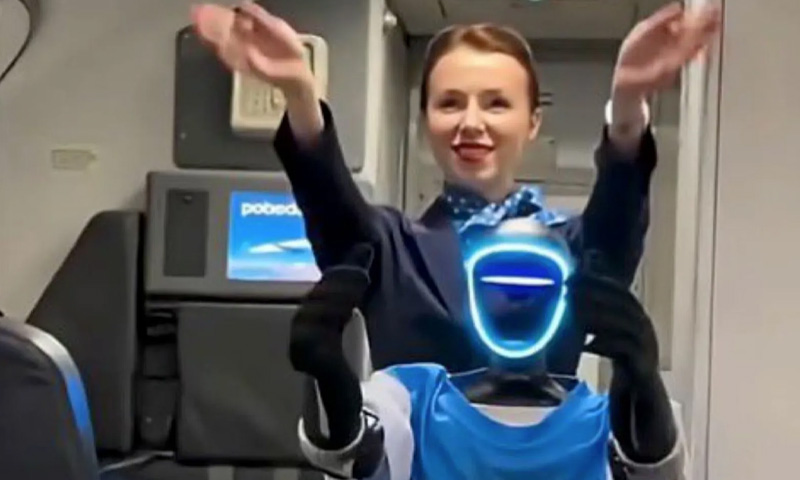
A European low-cost airline recently experimented with a humanoid robot serving as a flight attendant, greeting passengers, demonstrating safety procedures, and even verifying boarding passes during a commercial flight.
The AI-powered robot, named Volodya and developed by Unitree Robotics, made its first appearance on a Boeing 737 journey from Ulyanovsk to Moscow. The trial, described as a spontaneous experiment, reportedly went better than expected.
Volodya is designed to be both sensitive and versatile, capable of performing movements ranging from backflips to Tai Chi, and handling delicate tasks like soldering. Pobeda, the Russian budget airline and subsidiary of Aeroflot, put the robot to the test in a real-world cabin environment.
Dressed in a blue crew-style t-shirt, Volodya welcomed passengers with handshakes and checked multiple boarding passes before moving to the front of the plane to assist with pre-flight safety instructions. Once the flight was underway, the robot walked the aisle, interacted with travelers, and then returned to its seat for landing.
However, travelers shouldn’t expect to see robots replacing humans anytime soon. Pobeda is currently banned from operating flights into the European Union, and Volodya’s performance confirmed that human crew members remain essential. While the robot successfully completed its programmed tasks and engaged with passengers, all safety measures, service duties, and cabin management were handled by human attendants.
The lightweight robot also has limitations: it struggles to maintain balance during turbulence and cannot fully perform the duties of a professional flight attendant. Pobeda emphasized that the flight was purely a supervised technology demonstration.
In other aviation innovation news, Otto Aerospace is developing a futuristic £14.5 million aircraft called the Phantom 3500, which replaces traditional windows with high-tech exterior screens to give passengers immersive views. Set to launch in 2027, the jet boasts an ultra-smooth fuselage that reduces drag, improves fuel efficiency by roughly 60%, and extends range.
The Phantom 3500 features a spacious two-meter-high cabin for nine passengers, advanced cockpit avionics, and real-time video feed systems offering uninterrupted outside views. FlexJet has already placed a bulk order for 300 units of the new jet, highlighting the growing interest in next-generation travel technology.
You May Also Like


